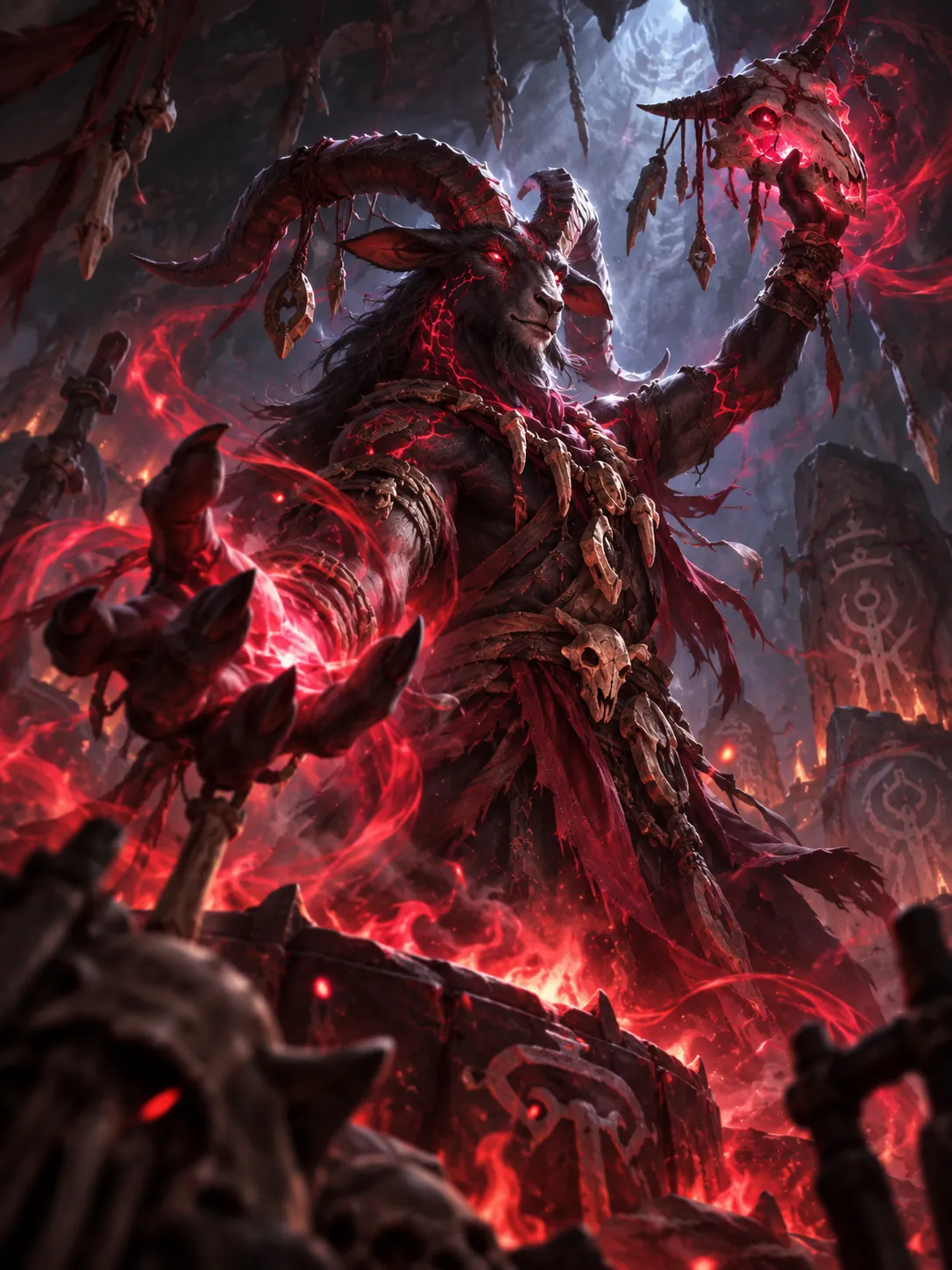
Born of the draconic forge, the Nnor are goat-like humanoids shaped by Charon, the Primordial Dragon of Fire. An elemental spark flows through them. Strong and nimble, they live in the high mountains or in volcanic caverns, carrying an inner fire that stands for freedom and for devotion to their maker alike. Close-knit, fierce and proud, they each bear the same inner flame, a symbol of freedom and devotion.
Charon, addressing Saman, his emissary, after he had passed the Ritual of Fire.
“Saman, hear my voice: the Nnor are not mere servants of my flame, but its guardians. You sow the spark of the primordial fire in every heart in Eden, freeing the peoples from the shadow and reminding all that freedom is born of passion. Go, forge your colony, and see that my fire never goes out.”
Playing Nnor characters
Adulthood
Around 50 years for Charon's Nnor, a little earlier for Alpine Nnor
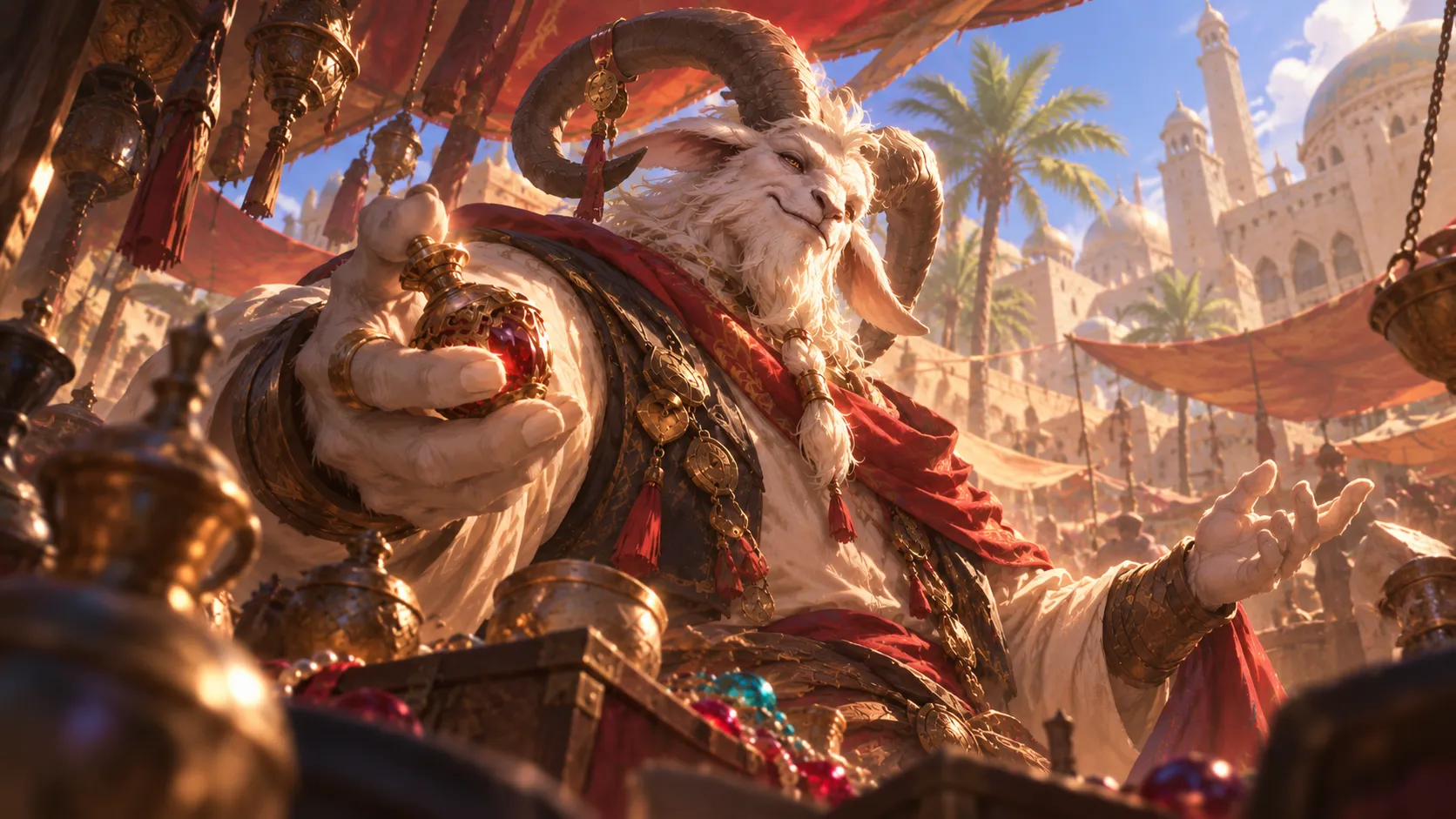
As an Alpine Nnor, you come from a Yurta that elects its own Saman, who answers to no Dragonnor, and where everyone takes a share of the work. Your fur is white, grey or light brown, sometimes with gold or russet highlights like the first sun on the peaks, and your eyes range from moss green to glacier blue. Your people are traders and artisans: they come down the snowy slopes to the spice and cloth fairs, where they barter hides, metals and works of art. Town dwellers are struck by their honesty in business, and by the care they take not to spoil the trails their caravans follow.
Charon's Nnor
As one of Charon's Nnor, you belong to the line that stayed loyal to the Primordial Dragon of Fire. In your Yurta, the workers obey the Saman, and the Saman answers to the Dragonnor that founded the Yurta: a former Saman transformed by the Ritual of Fire in Charon's Lair, on Mount Edros. Your ink-black fleece is streaked with fine veins that glow red, your eyes have the crimson gleam of an ember, and your horns are the colour of coal. You hatched from an egg laid by your Yurta's Dragonnor, and you lay none yourself. The silence of the underground galleries is familiar to you, and it is in the shadow of the hissing volcanoes that your Yurta celebrates its devotion to Charon.
Names
A Nnor, whether Alpine or one of Charon's, stays nameless until their Saman gives them a first name in a rite, and that name never changes. They also carry their Yurta's name as a family name, handed down from generation to generation. Alpine Nnor, who are male or female, bear first names that evoke the mountain and the cold; Charon's Nnor, who are neither male nor female, bear first names imbued with the primordial fire. No nickname is given unless a notable deed warrants it.
Across the sheer ridges and frozen crevasses of Eden, the Nnor cut a commanding figure: a broad chest borne on powerful shoulders, and long, muscular legs that end in hooves as sharp as crampons. Their coat is thick and woolly, and its colour depends on the lineage. Some wear fur as black as ink, while others range from spotless white to pearl grey or earthy brown, shades that serve as natural camouflage.
They use their massive horns, which follow the line of the brow, to defend themselves, to hold on to rock walls and to assert social dominance. Every muscle stands out beneath the heavy fleece, the sign of uncommon endurance and of millennia spent adapting to violent winds and extreme temperatures. Shaped by the harshness of the mountain climate, their build pairs raw strength with a surprising suppleness, which makes them born climbers and formidable opponents.
The Yurta above all
For the Nnor, the tribe, which they also call the Yurta, is a sacred bond that ties every member to their people and to Charon. The Samans regularly summon all the workers to ceremonies where the ancestral sagas are sung; there they renew the oaths of loyalty and rekindle the primordial flame. Their title is the name of Saman, Charon’s emissary, and they bear it in his honour. Tribal councils, with the Saman presiding, give each member their tasks (hunting, craftwork, gathering medicinal plants or raising stone altars), with a constant eye to the cohesion and survival of the tribe.
The Nnor have a supernatural gift: members of the same tribe seem to understand one another without a word spoken. Thanks to this almost telepathic communication within the tribe, they coordinate group manoeuvres with disconcerting precision, which helps them survive in hostile country, whether on a shared hunt or during a great winter migration.
An ancient schism gave rise to two main subspecies among the Nnor: Charon’s Nnor, marked by the draconic hierarchy, and the Alpine Nnor, who live communally. In the tribes loyal to Charon, the caste is made up of workers subject to the Saman, who in turn answers to the Dragonnor, chosen by the Ritual of Fire. In the communal tribes, the members elect a single Saman democratically, without any draconic intervention, and everyone takes an equal part in the tribe’s work.
Araskha, the largest Yurta known, lies on Mount Edros and is home to thousands of Nnor. Sheltered beneath a vault of basalt, it is laid out around a great eternal hearth, from which countless galleries branch off to house forges, workshops and sacrificial altars. To break the unity of the tribe is to break the chain that binds the Nnor to the very source of their existence.
The cycle of fire
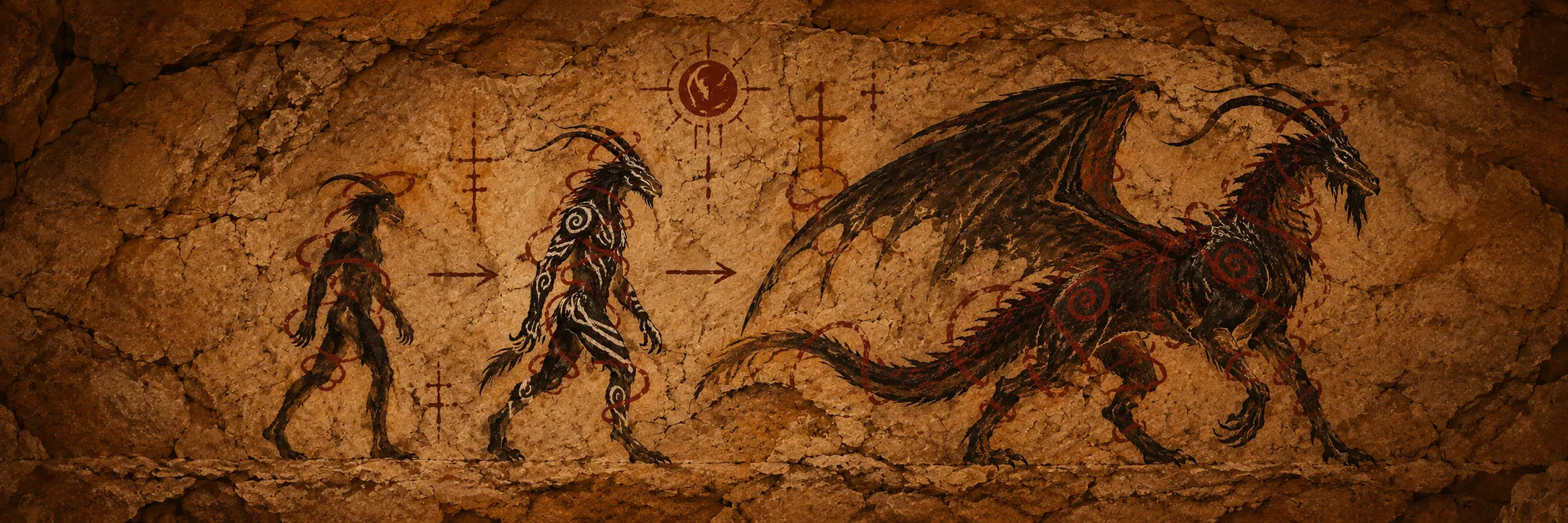
A mural of the cycle of fire: a Nnor, a Saman, then a Dragonnor
The Dragonnor is sometimes counted among the subspecies of the Nnor, but specialists hold the Dragonnor and the Nnor to be two entirely different beings. A Dragonnor has neither the limbs nor the size of a Nnor, and its abilities differ too: it alone begets Charon’s Nnor. It fertilises itself and lays the eggs from which they hatch. Charon’s Nnor themselves lay no eggs.
After begetting its first lineage, the Dragonnor falls into a deep torpor. Its body stays motionless while its consciousness seems to wander far beyond it. This state, often mistaken for sleep, makes up most of its existence.
On hatching, the young Nnor instinctively leave their progenitor’s lair and block up its entrance with stones, branches and foliage. Left to themselves, they learn to survive together.
Once the lineage is mature enough, one of the Nnor hears the Dragonnor’s call. Guided to the lair, they receive a fraction of its power and become a Saman, charged with protecting their kin and watching over their future Yurta. From then on, they alone speak with their progenitor.
When the Dragonnor dies, its Saman feels an instinctive need to join Charon at Araskha, on Mount Edros, and face the Ritual of Fire, a mystical rite whose secret the Samans, the Dragonnors and Charon keep among themselves. A Saman can also make this journey of their own free will, provided they have first trained a successor to watch over their Yurta.
The Saman reaches Charon’s Lair, where Charon allows them to undergo the ritual. If they fail, they die. If they succeed, the ritual transforms them into a Dragonnor, which comes back out of Mount Edros to find the place where it will establish its own Yurta. Such is the cycle of the Nnor.
For the Alpine Nnor, this cycle is far shorter. At the winter solstice, they return to their Yurta to elect their Saman or keep the one they have, at a great celebration held around a fire so mighty that Charon himself is said to have breathed it. At that time of year, many travellers below the mountains complain of avalanches, mud and other run-off: the fire seems to melt the snow.
Where the wild meets the city
A merchant emissary from Araskha who has set up shop in Aïn-Dahab
Faithful as they are to their mountains, the Nnor feel a growing curiosity about the human cities nearby. Those whose Yurta lies beside a great market learn to deal in hides, metals and spices, and gladly barter their handiwork for cloth or musical instruments.
Ever careful not to upset the natural balance, they make sure their caravans harm neither the trails nor the surrounding wildlife. Their fascination with civilisation shows in their art as well, in frescoes inspired by city mosaics and in sculptures that blend goat-like frames with human motifs: proof that, for the Nnor, progress and respect for the wild can go hand in hand.
Fiery-hearted mountain folk
The Nnor are cheerful by nature. Playful and fond of pranks, they like to break up their labour with jokes the whole group shares, and will go as far as staging proper skits together. Their mood has an edge of fierce pride, though: mock them or threaten their tribe, and their anger can break as suddenly as a mountain storm. For all their loyalty to the Yurta, they remain curious and open.
The Nnor are known for unfailing endurance and steadfast loyalty. People praise the way they face the worst conditions with unshakeable courage while keeping a keen sense of honour and tradition. Their talent for trade often surprises city dwellers, as much for the quality of their dealings as for their uncompromising honesty.
Their deep respect for nature shows in everything they do, even when they venture away from their mountain, and they take scrupulous care never to upset the balance of the places they frequent. Yet beneath this outward good humour smoulders a fierce pride: any slight against their Yurta or threat to their tribe can set off an anger as swift and relentless as a storm on the high peaks.