Species
DraftScothan
- Origin
- Depends on the parent Species
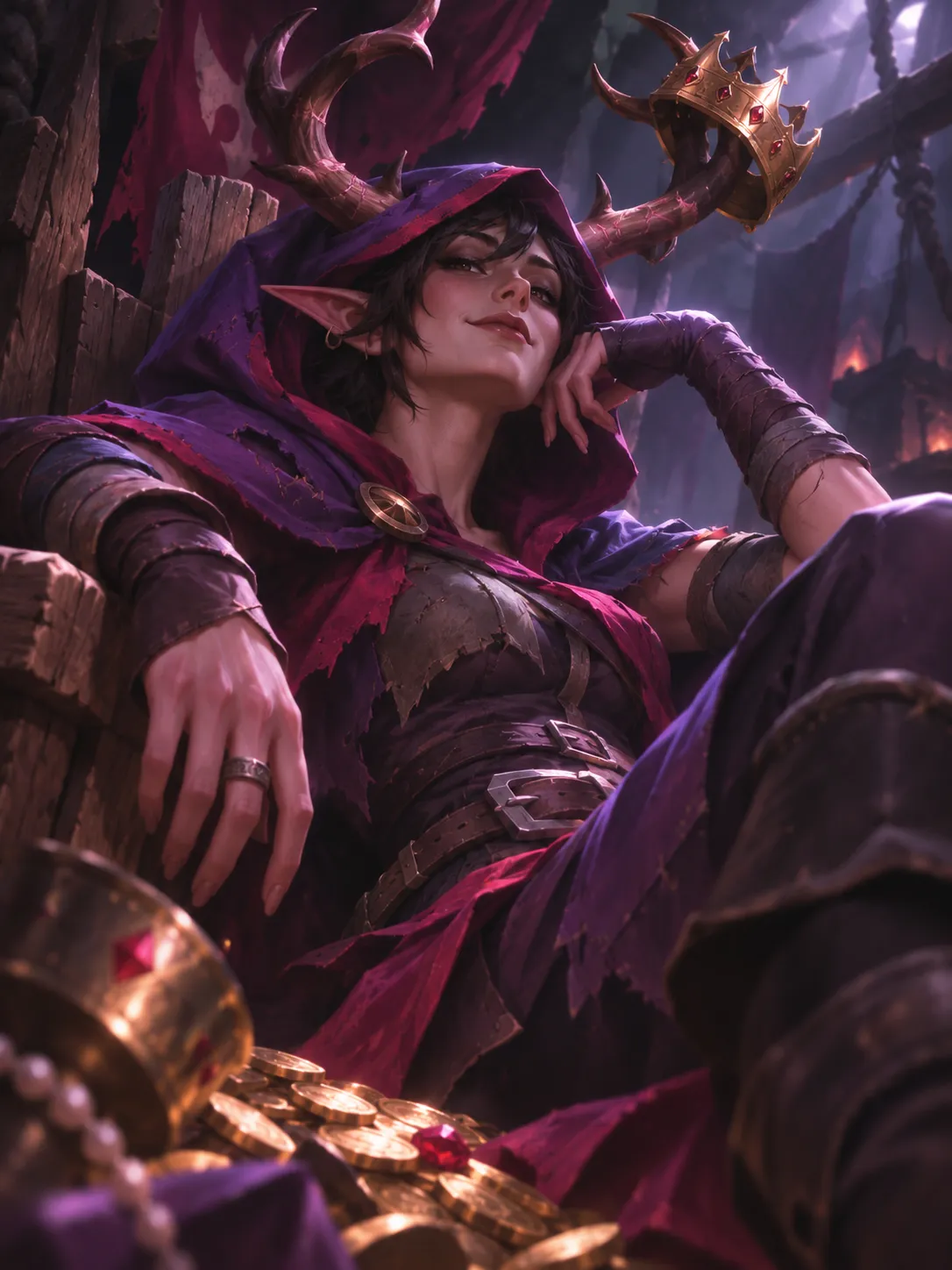
Scothans are the children of two peoples. Fir Bolg antlers rise above an elven brow, troll tusks jut beneath a human nose, a tiefling’s tail curls around a gnome child’s ankle. Scales, voices, bone structure and old gifts resurface from one generation to the next in families that do not always know what to make of them, and every Scothan learns early which features make a neighbour smile and which make them bolt the door.
The word is old Galwarian. Scothan meant mixed blood, crossbreed, sometimes bastard, and everyone still picks the translation that suits them. For centuries it was thrown in their faces at court, in the market and at the foot of the registers. Today’s Scothans claim it, and now they are the ones who say it first.
Tiar: “Before the matrons, you will cover those antlers. They are hideous.”
Shadeheart: “My mother never asked me to cover them… Your Majesty.”
Tiar: “Hmph. Your mother never asked anything of you, and it shows. Cover them, or have them cut.”
Shadeheart: “Huh… Cutting them won’t make me an elf.”
Playing Scothan characters
A Scothan is born of two different Species, their parent Species. Flesh of the OneSpecies SkillsFlesh of the OneThe first time you memorise this Skill, choose the parent Species your body comes from and, if it has any, one of its subspecies or regional origins. Its Size, its height and its Speed are yours. If it offers more than one Size, keep one.…Open the entry → gives you the body of one, Blood of the OtherSpecies SkillsBlood of the OtherThe first time you memorise this Skill, choose the parent Species your lineage comes from and, if it has any, one of its subspecies or regional origins. Its creature type or types, its lifespan, its age of adulthood and its languages are…Open the entry → the lineage of the other.
Also decide how much of your blood you let show. Many Scothans hide a trait to pass for one of their parent Species, while others wear theirs with pride. If flesh and blood could not have brought you into the world and it took magic for you to be born, you are a Garthae, and the Oracles hunt you down to kill you.
Species Skills
Nothing to show yet.
Every entry here is a draft. Turn off Hide drafts to see them.
No results.
Drop a filter or clear the search to see the full list again.
A bad omen
Before the Second Radiance, the birth of a Scothan was taken for a bad omen. In several elven kingdoms the midwives refused to enter the room, and the mother gave birth with only her sisters to help. Orc clans raised the child among their own but barred it from inheriting: a son could carry his father’s weapons and never receive his name. In halfling villages the clerk entered the newborn with the parents’ line left empty, and that blank line followed the child for life. When a harvest rotted in the field or a spring ran dry, every eye turned to the same house.
Many parents chose to hide their children. Some gave them to the temples, some to a distant uncle who asked no questions, and others kept them at home until whatever gave them away could vanish under a hood. Those who reached adulthood nearly always left. Belonging wholly to no people, they found work wherever a stranger was needed: settling a quarrel at a toll gate, leading a caravan through contested country, guiding a company over a pass no one else knew. Job by job, they came to know the roads of Eden better than those born on them.
Allies of the humans
Then the humans came to Eden, with their weapons and their own ambitions. The old omens meant nothing to them. A child with an orc’s jaw and an elf’s eyes was just one more stranger, and above all a stranger who knew the land. Scothans knew which lord charged a toll, which river flooded in spring and how to greet a sentry at an elven gate. The human courts hired them as messengers, interpreters and scouts, and for the first time they were paid for what they had always been blamed for: never quite belonging anywhere.
When the human armies crossed the elven borders, many Scothans marched with them, and the war lasted more than half a century. Some fought for pay, some for the citizenship promised at the end of the campaign, others for the doors once shut in their mothers’ faces. In the forests of the Brécelann, Scothans sometimes crossed blades with cousins who had stayed on the elven side. Both camps kept the stories, and the elven houses have forgotten nothing: a Scothan visitor is still asked under which banner their family fought.
A new generation
In the end the war drained armies and treasuries alike. Borders hardened, markets reopened, and soldiers who had watched each other across a palisade found themselves haggling over grain in the same square. Their children played between the stalls while the adults argued over the weight of the sacks. In those post-war towns a new generation grew up: Scothans with neighbours of the same descent, grandmothers who knew their human friends by first name, and sometimes a school where no one asked them to hide their horns.
The registers caught up more slowly. Clerks got used to writing half-elf or half-orc on birth certificates, because those unions were becoming common. For a less familiar parentage the line stayed empty, and the family went back out to find a witness willing to sign.
Between two peoples
How a Scothan is received depends on the ancestry people see in them. An elven line opens many drawing rooms, a goblin line still earns a search at the servants’ door, and a well-known family name protects you in one town while in the next the watch knows the name and makes the arrest anyway. There is a story of a Scothan master-at-arms who won the spring tournament of a human city and, that same evening, had to show his papers at the bridge to get home.
Many learn to pass unnoticed. They file down their horns, tuck their tails under a cloak, shorten a family name that says too much. Figaro, born of a gnome and a tiefling, hid his horns under a wool cap for years; his neighbours took him for a bad-tempered gnome, and he took care never to set them straight. Others refuse to hide and accept the cost. More than one mother, having seen the watch search her house, begs her child to put their hat back on before going out.
The pride of the Contingence
For many Scothans, everything changed the day Shadeheart refused to cover her antlers. Daughter of Princess Lyra and granddaughter of Queen Tiar Vyrefiel, she wore the antlers of her Fir Bolg line on her brow, and the queen demanded she hide them before the matrons. Her answer had gone around the court before supper. Soon afterwards she founded the Contingence.
Contingence houses give Scothans work and a bed when the watch is after them. Their doors have been widened to let antlers through, and no one there asks a newcomer to shorten their name. The guild has not stopped at bread and a roof. It has broken up auctions where Scothans were sold, forged passes, freed prisoners and publicly denounced magistrates who held Scothans to laws no one else answered to.
Its methods divide even its own members. A successful escape brings a captive home and, by the next morning, draws the watch to every Contingence house in the city. Several members of the Contingence are wanted on warrants, and the families who shelter them keep those notices where the children won’t find them.
The Garthae
Among Scothans, some carry a heavier name still. Garthae, in Galwarian, means something between impossible and forbidden. It is given to children whose parents, by every known rule, could never have conceived them. The midwife knows the mother’s name without finding any explanation the village will accept. Some families speak of a god, others confess to alchemy; the neighbours speak of witchcraft.
The children of Charon’s Nnor are the best known of them. Charon’s Nnor hatch from the eggs of a Dragonnor, which fertilises itself, and everyone knows that outside that cycle they never bear young: a child one of Charon’s Nnor has had with another people is therefore always Garthae. These Scothans are often cursed in the towns and villages they pass through, and shutters close behind them. The child of a Cindersöhls carries the name too, though that artificial body was never carried in a womb. Other Garthae each have their own story, repeated long after the family has moved on, and it only takes one neighbour seeking the Weitzguard’s favour for an Oracle to learn where the child went.
Hunted by the Oracles
The Weitzguard sends its Oracles to find the Garthae and look into their births, and most of these inquiries end in an order of execution. The official doctrine fits in a few lines: every Garthae proves that a breach has opened in the natural order of Eden. What was done once can be done again, the Oracles argue, and whoever learned the method could breed impossible lineages and turn them into weapons. So they search houses for ritual objects, question the midwife, the neighbours, everyone who attended the birth, and follow the trail from town to town.
The Garthae learn to live under borrowed names and to spot the inns that ask for a birth certificate. The Contingence hides a few of them. Village witches sell charms said to cloud divination, and families burn their registers, then tell anyone who will listen that the child died long ago. Now and then an Oracle comes back, years later, to check that story, and finds that the dead child has grown up and keeps a shop in the next town.